The Arctic in a New Geopolitical Reality
The Arctic has in a short time gone from being a geographic periphery to a region at the centre of geopolitics, security, trade and the green transition. At the same time, international interest in the region continues to grow, as great power rivalry, natural resources and emerging shipping routes reshape the conditions for cooperation and development.
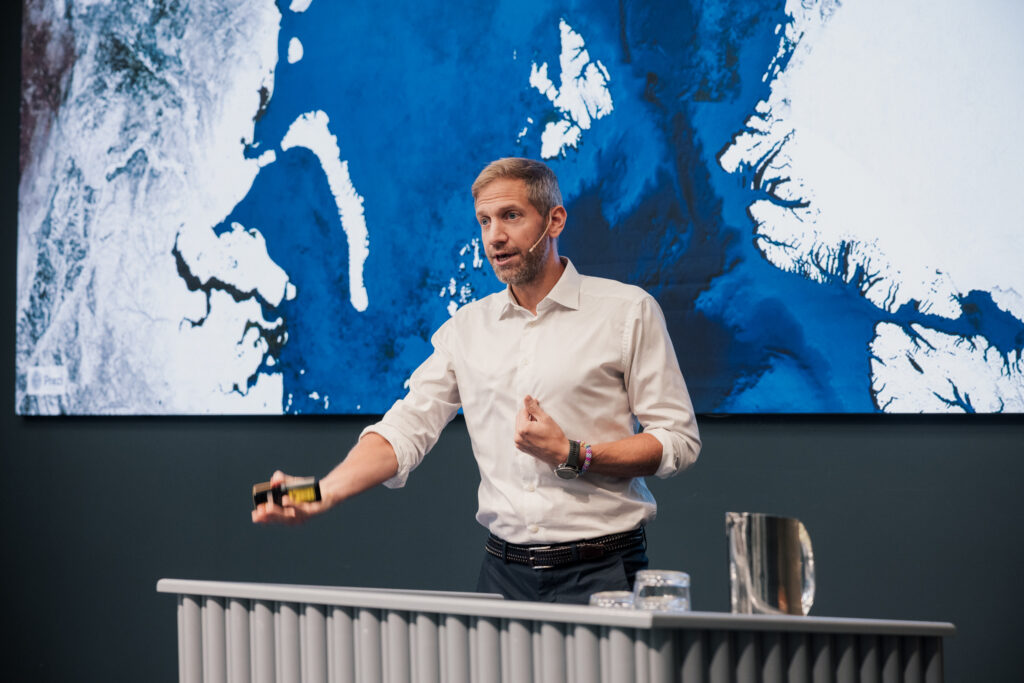
Andreas Østhagen is Director of Arctic and Ocean Politics at the Fridtjof Nansen Institute (FNI) and one of the Nordic region’s leading experts on Arctic geopolitics. In his new book, Arctic Geopolitics, he challenges established perceptions of the Arctic and examines how security, geography and regional cooperation are shaping developments in the High North.
We spoke with Andreas Østhagen about the future of the Arctic, Sweden’s role in the region, and the opportunities and risks facing businesses, investors and policymakers in an increasingly strategic part of the world
1. The Arctic has long been described as a region characterised by cooperation. How would you describe the prospects for international cooperation in the region today?
The idea of the Arctic as an “exceptional” region – insulated from geopolitics elsewhere – was always more fragile than the rhetoric suggested. It was a product of a specific window, roughly from the end of the Cold War until 2014, when Russia and the West found it convenient to cooperate on functional issues like search and rescue, science and fisheries management through the Arctic Council. That window is now largely closed. Since Russia’s annexation of Crimea, and especially since the full-scale invasion of Ukraine in 2022, the seven Western Arctic states have paused most formal cooperation with Russia, and the Council itself has struggled to function as anything more than a shell for non-Russia-related work.
That said, I would resist the temptation to declare cooperation dead across the board. What we’re seeing is not the end of Arctic cooperation, but its fragmentation: functional, technical cooperation on things like environmental monitoring or search-and-rescue protocols largely continues at the operational level, even as high-level political engagement with Russia has stopped. Cooperation among the seven Western Arctic states – on defence, infrastructure, and Indigenous issues – has if anything deepened. So the honest answer is that cooperation hasn’t disappeared, but it has narrowed geographically (excluding Russia) and shifted in character (from a symbol of post-Cold War optimism to something more transactional and security-conscious).
2. What do you see as the greatest challenges to preserving cooperation in the Arctic over the next decade?
Three stand out. First, the militarisation dynamic: Russia has invested heavily in its Northern Fleet and Arctic infrastructure since the 2000s as part of what I’d call a “bastion logic” – protecting its second-strike nuclear capability in the Barents Sea. NATO’s response, and Finland and Sweden’s accession, have deepened a security dilemma that makes low-level cooperation harder to sustain even where interests overlap.
Second, the entry of non-Arctic powers, particularly China, changes the political calculus. China’s self-declared status as a “near-Arctic state” and its growing scientific, commercial and potentially military interest in the region means Arctic governance questions can no longer be settled among the eight Arctic states alone – and the Western Arctic states are increasingly wary of appearing to concede ground to Beijing.
Third – and this is underappreciated – is the erosion of the assumption that geography is settled. For most of the post-Cold War period, everyone accepted that Arctic borders were fixed and disputes were manageable through the Law of the Sea. The Trump administration’s rhetoric on Greenland showed that even sovereignty over Arctic territory can suddenly become a live political question among allies, not just between Russia and the West. That’s genuinely new, and it complicates cooperation because it introduces uncertainty even within the Western bloc.
3. How is the increasing strategic competition between the United States, Russia and China affecting the prospects for trade, investment and economic development in the Arctic?
The “gold rush” narrative that dominated Arctic commentary around 2007–2008 – driven by high oil prices and USGS estimates of vast undiscovered resources – never materialised, and strategic competition is making it even less likely to. Sanctions on Russia since 2022 have cut off Western technology and capital from Russian Arctic energy projects like Arctic LNG 2, pushing Russia further into dependence on Chinese buyers and, to some extent, a sanctions-evading “shadow fleet” for its Arctic exports. That’s not really “development” in any normal commercial sense – it’s a workaround.
On the Western side of the Arctic, the picture is more one of caution than boom. Costs, ice, and distance were always the real barriers to Arctic resource extraction – Shell’s withdrawal from offshore Alaska and Norway’s own experience with fields like Wisting show that geology was rarely the limiting factor. Add geopolitical risk on top of that, and you get companies and investors becoming more selective, favouring projects with clear state backing (as with Norway’s Barents Sea fields) over speculative frontier investment. Strategic competition is, in other words, making Arctic economic activity more state-directed and security-vetted, and less driven by pure commercial opportunity than the “new frontier” narratives from fifteen years ago suggested.
4. What opportunities and risks should European businesses and investors pay particularly close attention to in the Arctic in the years ahead?
On opportunities: the clearest ones remain where geography, infrastructure and stable governance align – essentially the European Arctic (Norway, and to some extent northern Sweden and Finland). Established sectors like Barents Sea oil and gas, fisheries, and increasingly critical minerals and battery/data infrastructure tied to cheap, stable power are where the real, bankable activity is, not speculative shipping-route or offshore ventures further east.
On risk, I’d flag three things specifically. First, dual-use exposure: infrastructure, ports, or research stations that look commercially benign can become entangled in security politics – Chinese and other non-Arctic investment in Svalbard-adjacent projects has repeatedly triggered Norwegian state intervention on national security grounds, and European investors should expect similar scrutiny to apply to their own activity in sensitive areas. Second, the Northern Sea Route remains commercially and politically unreliable as a shipping corridor – it’s tied to Russia’s willingness to grant access and to a security environment that could deteriorate further, so European logistics firms shouldn’t treat it as a stable long-term bet. Third, regulatory and reputational risk from Indigenous rights and environmental litigation is rising, not falling – cases like Norway’s Fosen ruling show that projects can be legally approved and built, yet still face years of political and legal contestation that affects investor confidence.
5. Looking ten years ahead, are you more optimistic or concerned about the future of the Arctic, and why?
I’d call myself a realist rather than either an optimist or a pessimist, and I think that’s actually the more useful position. The alarmist “Arctic conflict is coming” narratives tend to overstate the risk of actual war over the region – there is no unresolved territorial dispute among the Arctic states, and the maritime boundary regime under the Law of the Sea has held up remarkably well, even through the Ukraine war. That’s a genuine success story that gets too little attention.
What concerns me is less the risk of war over the Arctic itself, and more the risk of the Arctic becoming collateral damage in confrontations that originate elsewhere – between Russia and NATO, or the US and China. Norway’s own position illustrates this: we’ve gone from a peripheral, low-tension corner of Europe to a country sitting directly in the geopolitical spotlight, without necessarily having built the knowledge base, public awareness or institutional capacity to manage that shift. My concern for the next decade isn’t primarily about ice, resources or borders – it’s about whether small Arctic states like Norway can hold onto agency and factual clarity in a region that outside powers increasingly want to define on their own terms.
An Arctic in Transition
The Arctic will continue to be a region where cooperation, security, economic interests and climate issues intersect in unique ways. As Andreas Østhagen points out, developments in the region are far more complex than the simplified narratives that often dominate public debate. For businesses, investors and policymakers alike, understanding both the geopolitical shifts and the emerging opportunities in the Arctic will be essential.
As global attention increasingly turns northward, knowledge of the Arctic’s dynamics is becoming an ever more important prerequisite for navigating a rapidly changing world. The Arctic may be geographically remote, but its significance extends far beyond the boundaries of the region itself.

About Andreas Østhagen
Andreas Østhagen is Research Director for Arctic and Ocean Politics at the Fridtjof Nansen Institute (FNI) in Oslo, where he works on Arctic geopolitics, maritime security and ocean governance. He is the author of Arctic Geopolitics: A Subregional Approach to Security and Geography (Cambridge University Press, 2026) and Ocean Geopolitics (Edward Elgar, 2022), editor of Norway’s Arctic Policy (Edward Elgar, 2023), and author of a forthcoming Norwegian popular-science book Isfronten (Kagge Forlag, 2027). He organises the annual Arctic Security Conference in Oslo and has held positions at institutions in Canada, Brussels and the United States, including as a Fulbright fellow.